

Reading Geology in Local Building Stones
Walk through almost any British town and you are walking through a geology lesson. The stones in the church tower, the boundary wall, the kerb beneath your feet were dug from the ground nearby — often within a few miles — and each one carries a record of an ancient environment. A red sandstone wall was once a desert or a river floodplain. A creamy limestone church was once a warm, shallow sea full of shellfish. Learn to read a few simple clues and you can begin to date a building, understand why it looks the way it does, and choose stone for your own garden that genuinely belongs.
Start with the Nearest Quarry, Not the Nearest Merchant
Until canals and then railways made heavy goods cheap to move, stone travelled badly. It was carted, barged or sledged, and every extra mile cost money. So for most of British building history, the stone in a wall came from the closest workable bed. Find your local geology map, look at what lies beneath the parish, and nine times out of ten the older buildings will be made of it. A village on Jurassic limestone builds in limestone; a village on Millstone Grit builds in gritstone. Where a church uses something exotic, that is usually a story about money, patronage or a later restoration.
Sandstone: Deserts, Rivers and Floodplains
Sandstone is the easiest family to read. Look at colour first: deep red or brick-red stone, as in Devon, Herefordshire or Angus, owes its hue to iron oxide formed in hot, oxidising conditions — often desert or dry floodplain settings. Grey and buff sandstones, such as the Millstone Grit of the Pennines or Yorkshire's flagstones, tend to come from wetter, deltaic and river environments.
Then look at the grain. Rub it with a thumb: coarse grit feels like sugar, fine stone like silk. On a weathered surface you may see cross-bedding — fine parallel lines set at an angle to one another. Those are the preserved fronts of sand dunes or river channels, and they tell you which way the current flowed. Sandstone fails by "sugaring", when the cement between grains dissolves and the surface crumbles, so it repays a good overhang and a sound roof.
Limestone: Warm Seas and Oolitic Shoals
Limestone is a marine rock and often generously fossiliferous. Carboniferous limestone — the grey stone of the Peak District, the Yorkshire Dales and the Mendips — is packed with crinoid stems, brachiopods and coral, and it is hard enough for drystone walls and massive foundations.
Softer, creamier limestones from the Jurassic, such as the Cotswold and Bath stones, are oolitic: made of tiny rounded grains that look like fish roe under a lens, formed in warm, agitated shallows. They cut and carve beautifully, which is why they appear in Perpendicular tracery and Georgian terraces. Portland stone, quarried on the Dorset coast, rebuilt London after the Great Fire. The Magnesian Limestone of Tadcaster, yellower and dolomitic, gives York Minster its warm glow. In Lias and Inferior Oolite walls, look for gryphaea — the "devil's toenail" oyster — and for ammonites, both excellent dating clues.
Granite, Slate and the Coming of the Railways
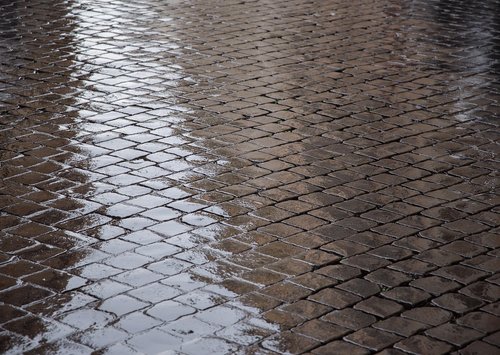
Granite is coarse, speckled and crystalline: Cornish, Aberdeen, Shap and Leicestershire varieties all appear in British building, usually as plinths, kerbs, steps and docks where toughness matters. It resists water, takes a crisp edge and greys beautifully with age. Slate is metamorphic, splitting into thin durable sheets: the Welsh quarries, Cumbria and Cornwall roofed much of Britain.
The tell-tale here is distribution. Once railways arrived in the 1840s, distant stone became affordable, so Scottish granite kerbs and Welsh slate roofs start appearing beside local limestone walls. That contrast is a useful date marker: if a building mixes far-travelled stone with local, it is almost certainly Victorian or later.
Flint, Ragstone and Rubble: Reading a Wall's Fabric
In the south and east, chalk country gives flint, used as knapped faces, coursed rubble and the chequer patterns of flushwork seen across Essex, Suffolk, Norfolk and Sussex. In Kent and south London, the greenish-grey Kentish ragstone turns up in Roman walls and medieval churches alike. Look closely at rubble walls for spolia — reused Roman brick or tile, or fragments of an earlier building — which can push a wall's date back centuries. Also note how the stone is laid: coursed and squared suggests money and skill, while random rubble with galleting (small chips packed into the mortar) is a practical, thrifty local tradition. Always lay stone on its natural bed; a mason who ignores bedding planes gives you a wall that delaminates in a decade.
Practical Fieldcraft for a Stone Detective
A good visit to an old wall needs no equipment beyond a hand lens, a notebook and patience. Here is what to record:
- Colour and grain: red, grey, cream, speckled — and how the surface feels.
- Fossils: crinoids, brachiopods, ammonites, gryphaea — these narrow the age of the rock.
- Bedding and tooling: angled bedding lines, diagonal chisel marks, combed or boasted faces, all reveal how the mason worked the stone.
- Weathering: sugaring on sandstone, pitting on limestone, and how lichens and soot cling differently to each stone type.
- Repairs and repointing: hard cement mortar traps moisture and damages soft stone; lime mortar lets a wall breathe.
- Changes in fabric: a medieval nave with a Victorian chancel in a different stone is a visible building history.
This reading habit pays off in the garden too. A drystone wall of local sandstone, a limestone paving path, a reclaimed trough or granite setts will settle into the landscape in a way that imported stone never quite does. Match the local geology, keep porous stone free-draining rather than sealed, and let frost and lichen do the rest of the work for you.
tag: Geology

Priya Nair Author
A basic mason's kit includes tungsten-tipped chisels, a wooden mallet, a dummy hammer and safety glasses for comfortable stone shaping.
YOU MAY ALSO LIKE
Essential Chisels and Mallets for the Stone Workshop
Aug 26
10Assess decay, remove loose material and replace or repair the sill with matching stone, preserving the window's character and weather resistance.
read more
Restoring a Weathered Stone Window Sill Step by Step
Aug 22
10Reclaimed setts, flagstones and brick edgings can create a relaxed cottage garden that ages gracefully and supports pollinators.
read moreMasonry
-

ERRIC CATONA
Porous stones absorb water, which expands when frozen, causing spalling; learn how to diagnose damage and choose suitable protective treatments.
May 19, 2016 at 5.12 pm
Reply
ERRIC CATONA
From simple mouldings to detailed foliage, traditional carving relies on patience, sharp tools and an understanding of stone grain.
May 19, 2016 at 5.12 pm
Reply -
ERRIC CATONA
Learn to recognise single, double and Galloway dykes by their stone size, through stones and coping arrangements in the British landscape.
May 19, 2016 at 5.12 pm
Reply
Heritage
Your email address will not be published.