

How Quarrying Shaped Local Architecture and Communities
Stone Comes From Somewhere Under Your Feet
Walk through almost any British town and you are, in a sense, walking through its quarry. The cottages, the church tower, the kerbs along the high street and the wall at the end of the garden often began as a seam of limestone, sandstone or granite a few miles away. Until railways made bulk haulage cheap in the nineteenth century, stone was expensive to move and cheap to dig, so builders used whatever lay closest to hand. That simple economics is the reason Yorkshire villages look nothing like Cotswold ones, and why the character of a town can often be read from the geology beneath it.
Geology Dictates the Look of a Place
Every stone has its own habits, and those habits shape buildings. Cotswold oolitic limestone splits into thin beds, so it was laid as coursed rubble and used for stone slates as well as walls, giving those villages their warm honey colour and steep pitches. Portland stone, a finer, more uniform limestone, could be sawn into large blocks and carved, which is why it appears in grand classical fronts rather than rough walling. Purbeck marble, despite the name a polishable limestone, was cut into slender columns for abbeys and cathedrals centuries before that.
Granite from Aberdeen and Cornwall is hard, coarse and stubborn. It resists the chisel, so it tends to appear in big, plain blocks and sturdy harbours, bridges and kerbs. Welsh slate from the slate districts split into thin, light, imperishable sheets and went onto roofs across Britain and far beyond. In flint country — Norfolk, Suffolk, Hampshire, Sussex and Kent — good building stone was scarce, so walls were raised in flint with lime mortar, sometimes galletted with small stones pressed into the joints to stiffen and tidy the face.
From Quarry Face to Cottage Wall
The journey from rock to finished wall was a chain of skilled hands. Getters loosened the stone with plugs and feathers, wedges and crowbars. Barrowmen and carters moved it to the banker, a raised working platform where dressers squared blocks with a mason's pick, a boaster and a mallet. Rough walling stone went off to local builders; better blocks became quoins, lintels, sills, copings and plinths, where a clean, sharp edge mattered most.
Mortar mattered as much as the stone. Traditional lime mortar is softer and more breathable than cement, allowing a wall to move gently with frost and settlement, and letting moisture escape. That is why old stone buildings often survive so well — and why repointing with hard cement can do real harm, trapping damp and spalling the face of the very stone it was meant to protect.
Quarrymen, Carters and Canal Boats
A working quarry was a small economy in itself. There were getters and dressers, of course, but also blacksmiths sharpening tools, wheelwrights keeping carts and barrows sound, and powdermen once blasting became common. Quarry wages built chapels, schools, pubs and reading rooms, and funded friendly societies that paid out when a man was injured or killed. The work was noisy, dusty and genuinely dangerous, and the silence after a quarry closed could empty a village as quickly as it had filled it.
Getting stone out shaped the landscape as much as getting it out of the ground. Early loads went on packhorses over causey roads; later came tramroads, incline planes and canals, with wharves and basins built specifically to take stone. Then the railways arrived and rewrote the rules, letting cheap stone travel far enough to compete with local material. Many towns still carry the fingerprints of that trade in street names, embankments and the flat, straight lines of old tramways.
Roads, Kerbs and the Public Realm
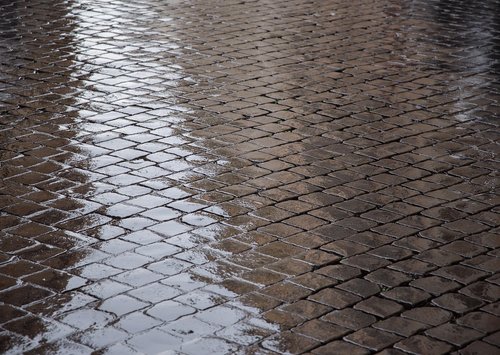
Quarrying also produced the fabric of the street itself. Granite setts and limestone kerbs, flagstone pavements, cattle grids, milestones, gateposts and boundary markers all came from local pits. Millstone grit gave us the millstones and grindstones that fed other industries entirely. Where stone was plentiful, even the drains, gutters and steps were stone; where it was scarce, brick and timber took over and the stone was reserved for corners and thresholds.
This is why repaving a high street matters more than it sounds. Get the material and the coursing right and a place feels like itself. Get it wrong — too uniform, too grey, too smooth — and the street loses the texture that made it legible in the first place.
Stone in the Garden
Gardeners inherit the same quarry legacy. Dry stone walls bound fields and gardens alike, built with a batter, a through-stone every metre or so, and a coping of stones set on edge to shed water. Flagstone paths, stone steps, troughs, kerbs and edging all echo local practice. Victorian rockeries were often built from quarry spoil and oddments, and stone from the same seam as the house always looks settled rather than imported.
- Match the source: if the house is sandstone, use sandstone paving; slate sits happily with slate.
- Reuse first: reclaimed setts, flags and copings carry a patina no new stone can imitate.
- Detail properly: lay flags on a permeable sub-base, fall them away from the building and keep joints free-draining.
- Think about scale: a small garden suits sawn paving and slim setts; larger plots can take riven flags and monoliths.
- Plant for the stone: thrift, aubrieta, campanula and ferns soften walls and crevices without undermining mortar.
Look closely at a local wall and you are reading a map, a wage ledger and a geological survey at once. Quarrying gave British towns their colour, their trade and much of their shape — and it still has plenty to teach anyone building or planting today.
tag: Heritage

Oliver Pemberton Author
Ask about origin, extraction methods and transport distance when buying stone, balancing durability, appearance and environmental impact for your project.
YOU MAY ALSO LIKE
Choosing Ethically Sourced Stone for Home Projects
Jul 9
10Ivy and climbing plants can trap moisture and hide defects; learn how to remove them carefully and protect stonework from future growth.
read more
Simple Ways to Protect Stonework from Ivy and Climbing Plants
Jul 4
10Letter cutting combines calligraphy, geometry and precise chisel work to create enduring inscriptions on slate, limestone and sandstone.
read moreMasonry
-

ERRIC CATONA
The right mortar mix depends on stone type, exposure and age; avoid hard cement mixes that can trap moisture and crack historic walls.
May 19, 2016 at 5.12 pm
Reply
ERRIC CATONA
A stable patio requires compacted sub-base, correct falls and jointing that allows water to drain away from your home.
May 19, 2016 at 5.12 pm
Reply -
ERRIC CATONA
Identify granite, limestone, sandstone, slate and flint in walls and roofs, and discover what each tells you about local geology.
May 19, 2016 at 5.12 pm
Reply
Heritage
Your email address will not be published.